Wired for Danger: The Neuroscience Behind Why Your Rescue Cat Still Can't Fully Trust You
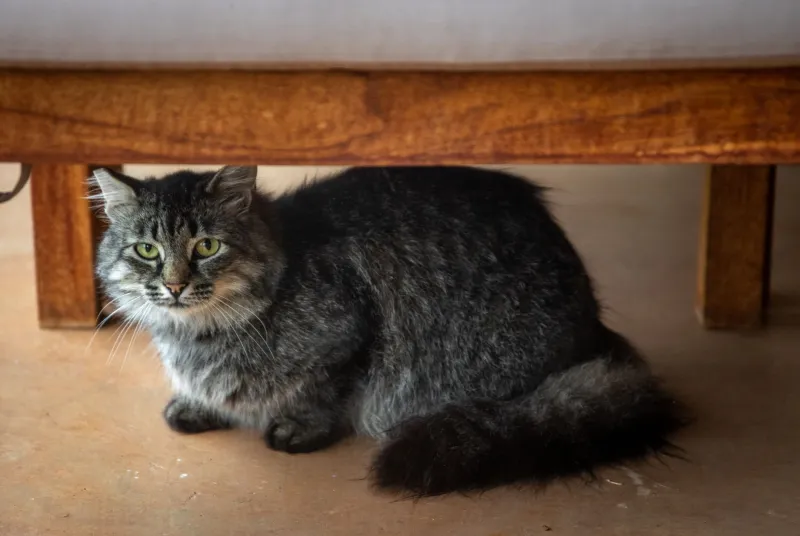
You did everything right. You set up a quiet room. You let her come to you. You resisted the urge to force cuddles. You bought the good treats. And yet, three months in, your rescue cat still presses herself flat against the wall when you walk too fast, still startles at the dishwasher, still watches the front door like it's going to betray her.
This isn't stubbornness. It isn't a personality flaw. And it definitely isn't proof that she'll never come around. What's happening inside that little body is something far more complicated — and far more biological — than most adopters are ever told.
Your Cat's Brain Didn't Get the Memo That She's Safe
Here's the uncomfortable truth: safety is a feeling, not a fact. And for a cat who spent months in a shelter, survived life on the streets, or came out of an abusive or neglectful situation, the nervous system doesn't automatically reset just because the threat is gone.
Cats, like all mammals, have what's sometimes called a threat-detection system centered in the amygdala — the part of the brain that processes fear and triggers survival responses. In a cat who's experienced chronic stress or trauma, this system gets recalibrated. It becomes hypersensitive. It starts flagging ordinary things — a stranger's voice, a plastic bag rustling, the sound of footsteps on hardwood — as potential dangers.
This is called hypervigilance, and it's not a behavioral quirk. It's a physiological state. The cat's body is literally running a different operating system than a cat who grew up feeling secure.
Dr. Mikel Delgado, a cat behavior researcher based out of UC Davis, has talked publicly about how chronic stress reshapes feline behavior at a neurological level — and how the effects can persist long after the stressor is removed. The brain, essentially, has learned to stay ready. And unlearning that takes more than time and a cozy blanket.
What Chronic Stress Actually Does to a Cat's Body
When a cat perceives a threat, her hypothalamic-pituitary-adrenal (HPA) axis kicks into gear and floods her system with cortisol and adrenaline. Heart rate spikes. Muscles tense. Digestion slows. Every system not essential to immediate survival gets deprioritized.
In short bursts, this is adaptive. It's what kept cats alive in the wild. But when a cat is living under chronic stress — months in a loud shelter, years of food insecurity, repeated exposure to unpredictable humans — that stress response stops being a short-term tool and starts becoming the default state.
The HPA axis can actually become dysregulated over time, meaning the system that's supposed to turn off the alarm keeps the alarm running even when there's nothing to sound off about. Cortisol levels stay elevated. The nervous system stays primed. And the cat, no matter how safe her new home actually is, remains physiologically stuck in survival mode.
This is why a rescue cat might seem "fine" in some moments and completely fall apart in others. She's not being inconsistent. She's operating with a nervous system that's been wired, through experience, to expect the worst.
The Problem With "Just Give Her Time"
The most common advice given to adopters of anxious rescue cats is also the most incomplete: give her time and space, and she'll come around.
Time and space are necessary. They are not sufficient.
Passive waiting assumes the cat's nervous system will naturally recalibrate on its own. For some cats — particularly those who experienced only mild or brief stress — it might. But for cats with deep trauma histories, the nervous system needs active support to shift out of hypervigilance. Left on its own, it may simply settle into a low-grade chronic anxiety that never fully resolves.
California shelters and rescue organizations are starting to recognize this. Groups like the San Francisco SPCA and various Southern California rescues have begun integrating behavioral assessments and post-adoption support programs that go beyond the standard "here's a pamphlet" handoff. The goal is to identify cats who are likely to need more than patience — and to give their adopters real tools.
What Actually Helps: Evidence-Based Approaches
So if time alone isn't enough, what works? Researchers and veterinary behaviorists are pointing to a few key interventions that show genuine promise.
Consistent, predictable routines. One of the most powerful signals a traumatized nervous system can receive is predictability. Feeding at the same time every day, interacting in the same low-key ways, keeping the household environment as stable as possible — these aren't just good cat ownership habits. They're neurological medicine. Predictability tells the threat-detection system that it can afford to stand down.
Positive, low-pressure social exposure. Forced interaction almost always backfires with anxious cats. But deliberate, gentle positive association — sitting near the cat while doing something boring, tossing a treat without making eye contact, letting her sniff your hand and then walking away — slowly teaches the brain that humans predict good things, not bad ones. This is classical counter-conditioning, and it works.
Environmental enrichment that builds confidence. Anxious cats often benefit from having more control over their environment. Cat trees, tunnels, window perches, and puzzle feeders aren't just entertainment — they give the cat agency. And agency, it turns out, is a significant buffer against chronic stress. A cat who can choose where to be, what to investigate, and how to engage is a cat whose nervous system gets regular "I'm okay" signals.
Pheromone support. Synthetic feline facial pheromones — the kind found in products like Feliway — mimic the calming chemical signals cats naturally deposit when they rub their faces on objects. The research is mixed but leaning positive, particularly for situational anxiety. California vets often recommend them as a low-risk adjunct to behavioral work.
Veterinary intervention when needed. This one still carries a stigma it doesn't deserve. For cats with significant anxiety, medication isn't a last resort — it's sometimes the thing that makes all the other interventions possible. Short-term anti-anxiety medications or longer-term options like fluoxetine can lower the baseline arousal level enough that the cat can actually start learning new associations. No amount of counter-conditioning works well on a nervous system that's too flooded to take in new information.
The Healing Isn't Linear — and That's Normal
Anyone who's lived with a traumatized rescue cat knows the two-steps-forward, one-step-back rhythm of recovery. She'll let you pet her for the first time and you'll cry a little. Then a week later she'll disappear under the bed for three days because a contractor came to fix the sink.
This isn't regression. It's just how nervous systems work. New stressors can temporarily reactivate old threat responses, even in cats who've made significant progress. The key is that over time, the baseline shifts. The hiding periods get shorter. The recovery time speeds up. The flinches become less frequent.
What California's most experienced cat behaviorists will tell you is that the goal isn't to produce a cat who never gets scared. It's to produce a cat whose nervous system has enough safety experiences stored up that it can bounce back — and eventually, trust.
That process takes longer for some cats than others. It requires patience, yes, but also intention. Your rescue cat isn't broken. She's running on hardware that kept her alive when her world was genuinely dangerous. Your job now is to help her learn, one small moment at a time, that this world is different.
She'll get there. Science says so.