3 AM and Fully Unhinged: The Real Science Behind Your Cat's Nighttime Chaos
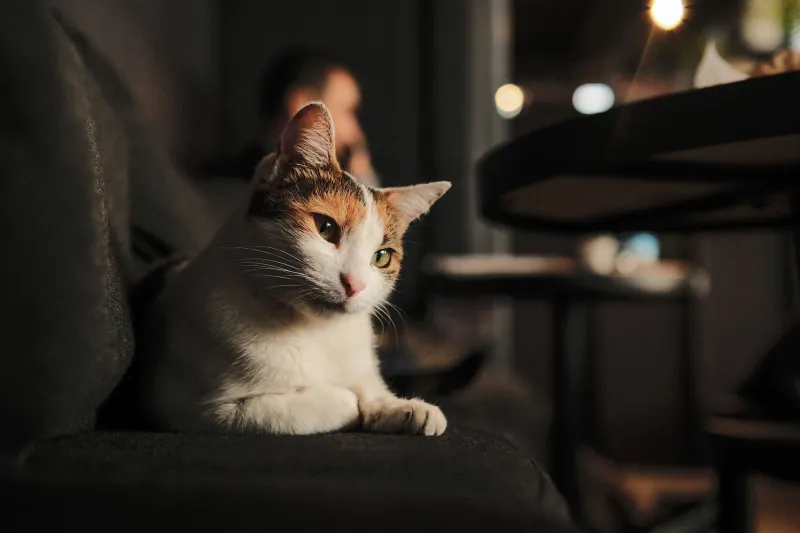
It's 3:17 AM. You're asleep. Then something that sounds like a small horse falling down a flight of stairs jolts you awake — except it's just your eight-pound tabby absolutely losing their mind in the hallway. Again.
If you share your home with a cat, you know this experience intimately. The zoomies. The phantom prey hunts. The inexplicable need to yell at the wall. It's chaotic, it's exhausting, and it turns out it's also deeply, fascinatingly scientific.
Your Cat Is Not a Nocturnal Animal (Sort Of)
Here's where a lot of people get it wrong: domestic cats aren't strictly nocturnal. They're crepuscular, meaning their biological peak activity windows are concentrated around dawn and dusk — the same low-light hours when small prey animals like mice, voles, and birds are most active and most vulnerable.
But here's the complication. Millions of years of evolution built cats to be opportunistic hunters, meaning they'll activate whenever prey is moving. In the wild, that could happen at 2 AM just as easily as at sunrise. Your indoor cat's brain didn't get the memo that the "prey" is a crinkle ball from PetSmart and that you have a 7 AM meeting.
Researchers studying Felis catus behavior have found that domestic cats often shift their activity patterns based on household rhythms — but only partially. They'll adapt to human schedules up to a point, then revert to instinct-driven bursts when the house goes quiet and dark. That quiet, dark house? It triggers something ancient.
Low-Light Vision and the Predator Brain
Cat eyes are engineering marvels specifically designed for the conditions that make humans most useless. The feline retina is packed with rod photoreceptors — the cells responsible for detecting motion and light in dim conditions — at a density that significantly outpaces human eyes. They also have a reflective layer behind the retina called the tapetum lucidum, which bounces available light back through the photoreceptors for a second pass. That's what causes the eerie eye-shine in photos.
What this means practically: when your living room is dark and you can barely see your hand in front of your face, your cat is operating in near-perfect visual conditions. The shadows that feel formless to you look like a detailed, high-contrast hunting ground to them.
At the same time, the brain's suprachiasmatic nucleus — the internal clock that regulates circadian rhythms — starts signaling that this is prime time. Cortisol and other neurochemicals associated with alertness and predatory readiness begin to rise. The combination of a visually rich environment and a neurochemical green light is basically a starter pistol for chaos.
The Hunting Sequence That Has Nowhere to Go
Cats don't hunt the way dogs chase things. Feline predation follows a specific, hardwired behavioral sequence: stalk, stare, crouch, pounce, grab, bite, kill. Every step of that sequence releases neurochemicals that push toward the next. It's a cascade, and it's deeply satisfying to complete.
Indoor cats — especially those without adequate daytime enrichment — build up what animal behaviorists sometimes call a "predatory debt." The instinct to complete that hunting sequence accumulates throughout the day without an outlet, and when the house goes quiet at night, it detonates. The zoomies aren't random. They're the end of a pressure valve.
This is also why cats that hunt (or play hunt) during the day tend to be calmer at night. The sequence gets completed. The neurochemical cycle closes. The cat sleeps.
What California's Indoor Cat Population Is Actually Dealing With
This matters a lot in a California context. Our state has some of the highest apartment-dwelling cat ownership rates in the country, and urban cats — particularly in dense areas like the Bay Area, LA, and San Diego — are overwhelmingly kept indoors, which is the right call for wildlife conservation and cat safety alike. But indoor life, without intentional enrichment, can leave a lot of predatory energy with nowhere to go.
Shelters and rescue organizations across California have been increasingly incorporating behavioral enrichment counseling into their adoption programs, recognizing that unmet predatory needs are one of the leading reasons cats get returned or surrendered. A cat that's "too hyper" or "won't let us sleep" is often just a cat whose instincts haven't been given a legal outlet.
What You Can Actually Do About It
The good news: this is one of the more solvable cat behavior puzzles out there. You don't need to accept 3 AM demolition derbies as the price of cat ownership.
Scheduled interactive play before bed. This is the single most effective strategy. Use a wand toy — something that mimics the movement of prey — and run a real play session 30 to 60 minutes before you want to sleep. Let your cat complete the full hunting sequence: stalk, pounce, catch. Then feed them a small meal immediately after. This mirrors the hunt-then-eat pattern their brains expect, and it's remarkably effective at triggering a rest cycle.
Puzzle feeders and foraging toys during the day. Scatter feeding, lick mats, and puzzle feeders break up the monotony of indoor life and give your cat's brain something to engage with during daylight hours. Less predatory debt = less midnight explosion.
Environmental enrichment that activates at dusk. Window perches with bird feeders outside, cat-safe TV content (yes, this is a real thing — YouTube has hours of bird and squirrel footage specifically made for cats), and rotating toy selections can help burn off energy during those natural crepuscular windows before the energy tips over into chaos.
Consider a second cat. This one comes with caveats — introductions need to be done carefully, and not every cat wants a companion. But cats that have appropriate feline playmates often manage their own predatory energy more effectively through social play.
Don't reward the behavior. If your cat wakes you up and you get up, feed them, or engage with them, you've just taught them that 3 AM is feeding time. It's hard, but ignoring the behavior — or using a white noise machine to sleep through it — breaks the reinforcement loop.
The Bottom Line
Your cat isn't being malicious. They're not broken. They're running predator software on a brain that hasn't meaningfully changed in thousands of years, in an environment that offers zero actual prey. The midnight zoomies are a feature, not a bug — a signal that your cat has instincts that need an outlet.
Understanding that reframes the whole thing. It's not chaos. It's a very small, very earnest apex predator doing their best in a world full of couch cushions and closed doors.
Give them a wand toy, a puzzle feeder, and a pre-bedtime hunt. They'll sleep. Eventually, so will you.