More Than Whiskers: The Hidden Sensory Superpower Built Into Your Cat's Face
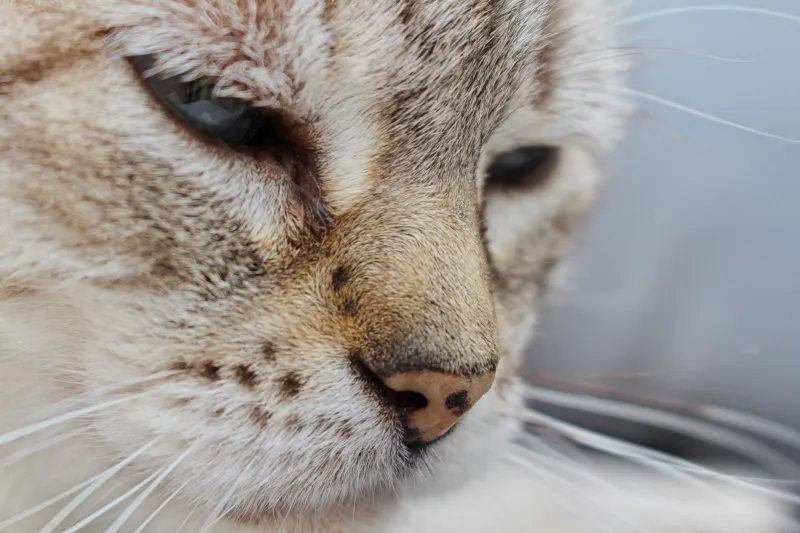
Let's be honest — most of us look at our cat's whiskers and think: adorable. Maybe we've noticed them twitch when our cat is curious, or fan out when they're feeling defensive. But there's a whole dimension of sensory biology happening in those stiff little hairs that most cat owners have never been told about, and once you understand it, you'll never look at your cat's face — or their food bowl — quite the same way.
Those whiskers? Scientists call them vibrissae. And they are, without exaggeration, one of the most sophisticated sensory organs in the animal kingdom.
What's Actually Going On Inside a Whisker
A cat's vibrissae are structurally nothing like the rest of their fur. Each one is rooted about three times deeper in the skin than a regular hair, embedded in a follicle packed with nerve endings and blood-filled sinuses that amplify even the most minute mechanical signals.
At the base of each whisker sits a dense cluster of sensory receptors called Merkel cells and Meissner's corpuscles — the same types of receptors found in human fingertips. When the whisker moves even a tiny fraction of a millimeter, those receptors fire signals directly to the brain's somatosensory cortex, which processes touch. In cats, a disproportionately large area of the brain is dedicated to processing whisker input — comparable to the amount of brain real estate humans devote to their hands.
The practical upshot: your cat's whiskers can detect air displacement from a moving object before that object even makes contact. They can sense pressure changes in a room. Some researchers believe they may even pick up subtle electromagnetic signals, though that area of study is still developing. What's not in question is that vibrissae give cats a kind of spatial awareness that operates almost like a sixth sense — a real-time map of everything happening in their immediate environment.
Whiskers Aren't Just on the Face
Here's something that surprises a lot of people: cats have vibrissae in more places than just their muzzle. There are whiskers above the eyes (which trigger a protective blink reflex), on the chin, and — this one really gets people — on the backs of the front legs, near the wrists. These carpal vibrissae help cats orient prey they're holding and navigate surfaces when climbing or landing.
The muzzle whiskers, arranged in four rows on each side, are the most sensitive and most behaviorally significant. They extend roughly to the width of the cat's body, which is why cats use them to gauge whether they can fit through a gap without having to physically test it. It's not magic — it's precision engineering.
Whisker Stress Is Real, and It Might Be Happening in Your Home
This is where the science gets immediately practical — and where California feline behaviorists are doing some genuinely useful work helping everyday cat owners.
When a cat's whiskers are repeatedly compressed or overstimulated, it causes what behaviorists call whisker fatigue or whisker stress. The nerves are sending constant signals to the brain, and the brain interprets that as a low-level but persistent form of sensory overload. The cat can't articulate what's wrong, but the discomfort is real.
One of the most common culprits? Deep, narrow food and water bowls. If a cat has to push their face into a bowl to reach the bottom, their whiskers press against the sides with every bite or sip. For some cats, this is enough to make mealtimes genuinely unpleasant — and it can manifest as what looks like picky eating, leaving food untouched even when hungry, or pawing food out of the bowl onto the floor.
Dr. Miriam Castillo, a certified feline behavior consultant based in the Bay Area who works with rescue organizations across Northern California, sees this regularly. "I've had clients convinced their cats had dental problems or food aversions, and the fix was just switching to a wide, shallow dish," she says. "Once you understand what whiskers are actually doing, a lot of cat behavior that seems random starts making sense."
The solution is simple: wide, flat dishes — sometimes called whisker-friendly bowls — allow cats to eat and drink without their vibrissae making contact with the sides. It's a small change with a potentially significant impact on your cat's daily comfort level.
Why You Should Think Twice Before Touching Them
Many cats actively dislike having their whiskers touched by human hands, and now you know why. The nerve density at the base of each vibrissa means that even gentle handling sends a strong sensory signal — not painful, necessarily, but intense and hard to contextualize. It's a bit like someone pressing firmly on your fingertips without warning.
Some cats tolerate whisker contact better than others, especially those who were well-socialized as kittens. But if your cat pulls back, flicks their head, or seems briefly disoriented when you touch their muzzle area, that's not attitude — that's a sensory system responding exactly as designed.
Please, also, never trim a cat's whiskers. This one is worth saying plainly. Trimmed vibrissae don't grow back immediately, and in the meantime, the cat is essentially navigating the world with a key sensory system disabled. Disorientation, clumsiness, and elevated anxiety are common results. It's not cute. It's genuinely harmful.
Designing an Environment That Works With — Not Against — Your Cat's Senses
Understanding vibrissae opens up a broader conversation about indoor cat enrichment that California behaviorists are increasingly centering in their work with rescue organizations and cat owners.
Cats in the wild are constantly receiving rich, varied sensory input — air movement from prey, the texture of different terrain, pressure changes that signal weather shifts or approaching animals. Indoor environments, by contrast, tend to be sensory-flat: still air, uniform surfaces, predictable routines. For a cat with whiskers tuned to detect the wing-beat of a moth three feet away, that's a lot of silence.
Some practical ways to enrich your cat's whisker-world:
Introduce gentle airflow. A small fan set to low, positioned so it creates subtle air currents around a perch or play area, gives your cat's vibrissae something to engage with. It mimics the sensory texture of an outdoor environment without any of the risks.
Vary surface textures. Different materials — cork, sisal, smooth wood, soft fabric — give cats tactile information to process. Rotating enrichment items keeps the sensory landscape fresh.
Use puzzle feeders thoughtfully. Puzzle feeders are great for mental stimulation, but make sure the openings are wide enough that cats don't have to compress their whiskers to access food. Test before you commit.
Give them window access. Moving air, the scent of the outdoors, and the visual motion of birds or leaves all provide sensory stimulation that matters. A window perch near a slightly cracked window (with a secure screen) is one of the easiest enrichment upgrades you can make.
Respect their space signals. When a cat's whiskers are pulled back flat against their face, they're in a defensive or anxious state. When they're fanned forward, the cat is curious and engaged. Reading these cues — and responding by giving space or inviting interaction accordingly — builds trust and reduces stress over time.
The Bigger Picture
Your cat is living in a sensory world you can't fully access. Their whiskers are picking up information from the environment constantly — information that shapes how safe they feel, how they navigate space, and how much cognitive load they're carrying at any given moment.
The good news is that you don't need to understand every neuroscience detail to make meaningful changes. Swap out the deep bowl. Skip the whisker touching. Add a little airflow. Pay attention to what their face is telling you.
These aren't big asks. And for your cat, they might make the difference between a home that feels stressful and one that feels genuinely safe.


