Sunshine State, Confused Cat: What California's Famously Mild Weather Is Actually Doing to Your Indoor Feline
Let's be honest — most of us moved to California, or stayed here, at least partly because of the weather. Seventy degrees in November? No ice to scrape off the windshield? Perpetual golden light? Hard to argue with any of that.
But here's something nobody puts in the California real estate brochure: that gorgeous, consistent, barely-changes-from-month-to-month climate might be quietly working against your indoor cat's health in ways that are only now getting serious scientific attention.
This isn't about sunscreen or heat stroke. It's about something subtler and, in some ways, more insidious — the biological expectation that the world will change, and what happens to a cat's body and brain when it mostly doesn't.
Your Cat's Body Keeps a Calendar (Even If You Don't)
Domestic cats evolved across thousands of years in environments that had real seasons. Not dramatic, polar-vortex seasons necessarily, but enough variation in daylight length, temperature, and prey availability to hardwire some pretty specific biological expectations into feline physiology.
The master clock governing all of this is the circadian system — a network of light-sensitive cells, hormones, and neural feedback loops that regulate everything from sleep cycles to immune function to reproductive behavior. In cats, this system is exquisitely sensitive to photoperiod, which is the technical term for the ratio of daylight to darkness across the year.
In most of the continental US, that ratio shifts dramatically. In Boston, you're looking at roughly nine hours of daylight in December and fifteen in June. That six-hour swing sends a cascade of biological signals that recalibrate hormone production, metabolism, coat cycling, and behavioral drive.
In San Diego? You're going from about ten hours to just under fourteen. A four-hour difference. Spread across twelve months. Barely a ripple.
For humans who spend most of their time outdoors or near windows, even that modest swing registers. For an indoor cat whose primary light source is a ceiling fixture on a timer set to the same schedule year-round — or no timer at all — the seasonal signal is functionally nonexistent.
What a Seasonless Life Does to a Cat
Researchers studying feline chronobiology — yes, that's a real field — have found that cats with disrupted or monotonous light environments show measurable changes in melatonin secretion patterns. Melatonin isn't just a sleep hormone; it's a key regulator of immune function, cellular repair, and mood. When its seasonal rhythm flatlines, downstream effects ripple through multiple body systems.
Some California-based veterinary behaviorists have noted anecdotally that indoor-only cats in the state tend to show more diffuse behavioral dysregulation than their counterparts in states with sharper seasonal contrast — things like unpredictable energy spikes, inconsistent appetite patterns, and what owners often describe as a kind of low-grade restlessness that never quite resolves. It's hard to pin on any single cause, but the chronic absence of seasonal cues is increasingly part of the conversation.
Coat cycling is another area worth watching. Cats naturally shed and regrow their coats in response to photoperiod changes. Indoor California cats often shed year-round in a kind of desynchronized, continuous trickle rather than the concentrated seasonal blowout you'd see in a cat with more distinct light exposure patterns. That sounds like a minor grooming inconvenience, but continuous shedding can indicate that the hormonal signals governing follicle cycles are perpetually stuck in a middle state — neither fully on nor fully off.
The Vitamin D Problem Nobody Talks About
Here's where things get a little counterintuitive. California is one of the sunniest states in the country, and yet indoor cats here may be chronically low on vitamin D — not despite the sunshine, but partly because of how we think about it.
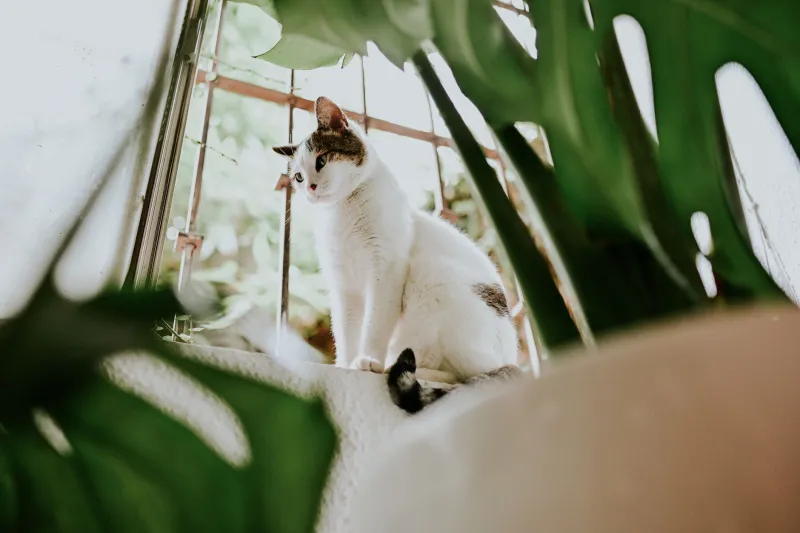
Cats synthesize vitamin D differently than humans do. Rather than producing it efficiently through skin exposure, cats rely heavily on dietary sources. The sun exposure cats do get can contribute, but here's the catch: standard window glass blocks the UVB wavelengths required for vitamin D synthesis almost entirely. Your cat basking in a sunny windowsill is getting warmth and visible light — but not the UV spectrum their body would need to synthesize D on its own.
Because California's climate feels so sun-drenched, owners may assume their cats are getting adequate UV exposure when they're really not getting any. Cats in colder states, ironically, may be more likely to have this gap flagged by a vet because the climate prompts more direct questions about light and nutrition. In California, it's easy to assume the sun is handling it.
Vitamin D insufficiency in cats has been linked to immune dysregulation, musculoskeletal issues, and emerging research suggests possible connections to mood and cognitive function. It's worth asking your vet about, especially if your cat is strictly indoors.
Recreating the Seasons Your Cat's Biology Expects
The good news is that this is a solvable problem — or at least a manageable one. You don't need to move to Minnesota.
Adjust your lighting deliberately. Smart bulbs and programmable lighting systems let you shift both the duration and the color temperature of your cat's indoor light environment across the year. In summer, longer periods of bright, cool-toned light. In winter, shorter days and warmer, dimmer evenings. This mimics what natural photoperiod would do and gives the circadian system something meaningful to track.
Invest in a catio or supervised outdoor time. Even 20 to 30 minutes of genuine outdoor exposure — real sunlight, real air temperature, real ambient sound — provides a quality of sensory input that no indoor setup fully replicates. California's climate, for all its sameness, is still genuinely outdoors. A screened enclosure on a balcony or patio gives your cat actual UV exposure, real temperature variation between morning and afternoon, and the kind of environmental richness that indoor life just can't deliver.
Talk to your vet about vitamin D. Don't supplement randomly — vitamin D toxicity is a real risk in cats — but do have a conversation. A blood panel can reveal whether your cat's levels warrant dietary adjustment, and many high-quality commercial cat foods are now being formulated with this gap in mind.
Vary temperature and texture, not just light. Cats whose environments include slightly cooler sleeping spots, warmer sunning areas, and seasonal variation in bedding material (lighter in summer, denser in winter) show more robust behavioral engagement. It sounds fussy, but it's just giving your cat's sensory system something to respond to.
California Is Still a Great Place to Be a Cat
None of this means California is bad for cats. The same mild climate that mutes seasonal signals also means no dangerous cold snaps, lower risk of certain parasites, and generally longer, healthier lives for indoor cats whose owners are paying attention.
But paying attention is the operative phrase. The very ease of life here — for humans and cats alike — can make it easy to miss the quiet biological needs that don't announce themselves loudly until something goes wrong.
Your cat's body was built to expect a world that changes. In California, you get to be the one who makes that happen.